
|
| You might also like: | Solstice | Earth's Seasons Quiz - Zoom Astronomy | Lunar Eclipse- The Moon | Axis Tilt and Earth's Seasons | Today's featured page: Timeline: US Constitution |
| Our subscribers' grade-level estimate for this page: 3rd - 4th |
| Go to a Leap Year Worksheet Go to a Time Theme Page Go to Calendar Pages |
EnchantedLearning.com Leap Year Learn what a leap year is, why we have leap years, and how often we have a leap year. |
Click Here for K-3 Themes |
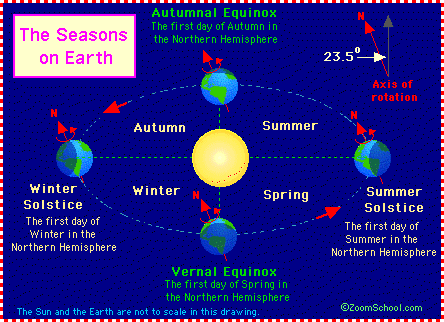 The Earth orbits the sun every 365.2422 days (0.2422 days is equal to 5 hours, 48 minutes and 46 seconds, roughly 1/4 of a day). Every 365 1/4 days (not exactly 365 days), the Earth returns to the same exact spot in its orbit. That is why we have a leap year roughly every 4 years, to synchronize the seasons with our calendar; if we had a 365-day calendar every year, the seasons would drift around the calendar. |
Why Do We Have Leap Years?
A year is defined as the time it takes for the Earth to orbit around the sun once. It takes the Earth about 365 1/4 days to make one entire orbit around the sun (a day is one rotation around the Earth's axis). By adding one extra day about every four years, the Earth is in the same point of its orbit at the same time of the calendar year each year.
Before a leap-year calendar was used, the seasons drifted around the calendar (the drift is about 1/4 day or 6 hours each year). For example, over three hundred years, July would go from summer to spring. Our current calendar is called the Gregorian calendar; this calendar was devised by Aloysius Lilius (an Italian physician) and named for Pope Gregory who decreed in 1582 that it be used in Catholic areas. This calendar wasn't adopted in Britain and the American Colonies until 1752.
What Years are Leap Years?
Usually, there is a leap year every four years -- but once in a long while, a leap year has to be skipped (this is because the Earth's orbit is 365.242 days, a bit less than 365 1/4).
To determine if the year is a leap year:
Leap Day Birthdays
People born on leap day (February 29) can celebrate their birthday on March 1 (or February 28) on non-leap years. A person born on a leap day is sometimes called a leapling.
What percentage of the population is born on leap day? Assuming an equal distribution of birthdays throughout the year, the fraction of people born on leap day is the fraction of people born on one day out of four years, or
Calendar Rhyme (Two versions)
|
Thirty days hath September, April, June, and November, All the rest have thirty-one, Excepting February alone, And it has twenty-eight days time, But in leap years, February has twenty-nine. |
Thirty days hath September, April, June, and November, All the rest have thirty-one, Excepting February alone, And that has twenty-eight days clear, And twenty-nine in each leap-year. |
| All Themes | Animals | Food | People | Plants | Sports | Time and Calendar | Holidays |
|---|
| A | B | C | D | E | F | G | H | I | J | K | L | M | N | O | P | Q | R | S | T | U | V | W | X | Y | Z |
Enchanted Learning®
Over 35,000 Web Pages
Sample Pages for Prospective Subscribers, or click below
|
Overview of Site What's New Enchanted Learning Home Monthly Activity Calendar Books to Print Site Index K-3 Crafts K-3 Themes Little Explorers Picture dictionary PreK/K Activities Rebus Rhymes Stories Writing Cloze Activities Essay Topics Newspaper Writing Activities Parts of Speech Fiction The Test of Time
|
Biology Animal Printouts Biology Label Printouts Biomes Birds Butterflies Dinosaurs Food Chain Human Anatomy Mammals Plants Rainforests Sharks Whales Physical Sciences: K-12 Astronomy The Earth Geology Hurricanes Landforms Oceans Tsunami Volcano |
Languages Dutch French German Italian Japanese (Romaji) Portuguese Spanish Swedish Geography/History Explorers Flags Geography Inventors US History Other Topics Art and Artists Calendars College Finder Crafts Graphic Organizers Label Me! Printouts Math Music Word Wheels |
Click to read our Privacy Policy
| Search the Enchanted Learning website for: |